Scott Fischer
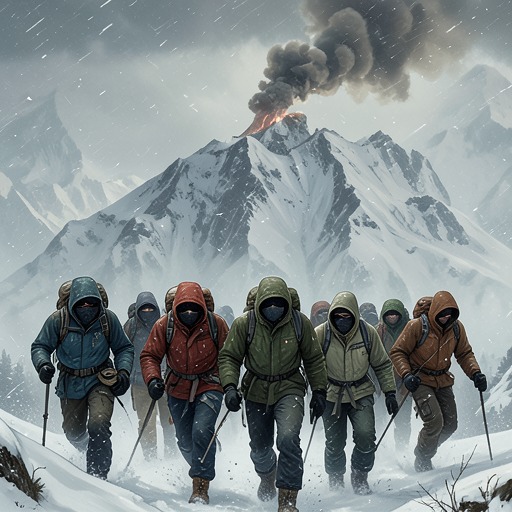
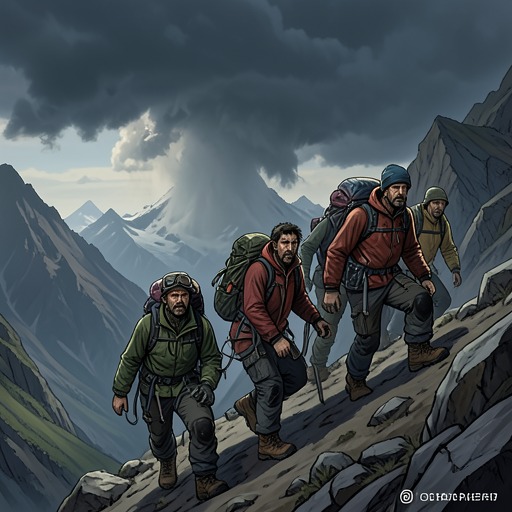
The ClimbScott Fischer was an accomplished high-altitude climber who turned Mountain Madness into an extension of his adventurous ambitions and, in 1996, a new commercial rival to Rob Hall’s established Everest operation. His charm helped attract clients, but the Everest venture carried stakes beyond a summit: its success could reshape the company and Fischer’s own future. He died on the descent during the May 1996 storm, in circumstances the book treats as the convergence of deteriorating health, oxygen, timing, communications, weather, and the limits of the people around him.
Identity and ambition
Based in West Seattle, Fischer was described as six feet four, with a symmetrical face and long blond hair, and possessed the charisma to attract clients and persuade them to commit money and effort. He had developed Mountain Madness since the early 1980s, but the business had not consistently provided a steady income. Climbing had been his central pursuit; the company made it possible. A successful commercial expedition on Everest promised to change the scale of both his business and his personal choices.
By 1996 Fischer was an established guide who had climbed K2 and Everest, and had turned forty the previous year. He was considering whether to keep returning to Everest’s summit or hire others to lead climbs. That possibility belonged to a wider reassessment of his personal life, work, and public identity. The Everest venture was therefore not merely another expedition: a successful season might finance the changes he was contemplating and allow Mountain Madness to build a larger program of major-mountain climbs.
The commercial opportunity was also a financial gamble. Mountain Madness saw demand among clients for an Everest expedition and a risk of losing them to competitors if it did not offer one; the potential return was substantial, but so was the chance of losing money. Fischer hoped to recruit clients at a price comparable to Rob Hall’s $65,000 fee and establish the company as a serious commercial operator. Most of his clients had not paid that full asking price. Sandy Hill Pittman, by contrast, paid more than the base fee after covering additional expenses, including extra Sherpas and a family member’s trek.
Building the Everest team
Fischer entered commercial guiding on Everest as a newcomer, but recruited guides whose experience he could present to prospective clients. His promotional material named Nazir Sabir, Neal Beidleman, and Anatoli Boukreev. Boukreev, a Russian climber living in Almaty, was already recognized for his high-altitude record: by spring 1996 he had climbed seven of the world’s eight-thousand-meter peaks, some more than once, without supplementary oxygen.
Fischer recruited Boukreev after the two discussed the risks of guiding at extreme altitude. Boukreev stressed the need for good weather, qualified guides, careful client screening, and climbers capable of taking responsibility for themselves. He cautioned that Everest could not be guided in the same manner as a lower mountain. Fischer responded by asking him to lead on Everest and proposing that they consider future work together in K2 and the Tien Shan. Boukreev already had a tentative offer from Henry Todd’s Himalayan Guides. Fischer pointed out that no contract had been signed and offered nearly twice as much. Boukreev accepted, appreciating Fischer’s climbing ability and confidence in his capacity to organize an expedition; he also respected Beidleman, whom he had assisted on Makalu.
The team’s client roster was taking shape by February 29, 1996, when Mountain Madness had signed eight climbers. Fischer told them he was excited about the group’s strength and the apparent compatibility of its members. He also reassured Lene Gammelgaard, who had not yet raised the full fee, that he wanted her on the expedition and that they would find a way to make it work. His efforts to recruit and retain clients reflected both personal commitment to the team and the commercial importance of a successful climb.
Pittman presented a particular opportunity. She had substantial high-altitude experience and an agreement with NBC Interactive Media to send daily reports to a website. Fischer’s friends and associates saw her presence as a potential source of major publicity if she reached the summit, and a possible public setback if she did not. The expedition thus joined the practical work of climbing to the public stakes of a commercial undertaking: clients’ progress could shape the company’s reputation as well as the expedition’s outcome.
Leadership and growing pressures
During acclimatization, the team’s readiness became uneven. Fischer repeatedly interrupted his own routine by moving up and down the mountain, and Boukreev grew concerned about the differences in the clients’ physical readiness. On one descent, Boukreev and Fischer talked about the route’s progress and the problems at Base Camp. Fischer described the deteriorating condition of Ngawang Topche Sherpa, the expense of getting him to Kathmandu for care, the use of oxygen from the team’s dwindling supply, and the failure to prepare Camp IV or carry oxygen to that altitude. They agreed to assess the Sherpa team after the expedition and consider who should work on future climbs.
The question of who should use oxygen brought Fischer into a heated dispute with Gammelgaard. She had expected more time to acclimatize and hoped to climb without supplementary oxygen, but the delayed establishment of higher camps had limited her opportunities to test her response to altitude. Fischer told her that she would have to climb with oxygen. She objected that he was changing the conditions she had trained for and expected, while Fischer maintained that climbing without oxygen was not a safe option for her. The disagreement ended without resolution.
Boukreev then spoke to Gammelgaard himself. He explained that, despite his own experience climbing Everest without oxygen, he had gone as high as the South Col before descending to continue acclimatization. Because Gammelgaard had not climbed above 7,300 meters and had little experience on which to judge her chances, he urged her to abandon the attempt without oxygen. He offered to assist her in a future effort if she first climbed with oxygen. Fischer later thanked him for persuading her, though both men still regarded her as an uncertain prospect at altitude.
Other clients also caused concern. Fischer thought Dale Kruse had been fortunate to descend when he did, since a later descent could have put him at serious risk of high-altitude cerebral edema. Pete Schoening still could not sleep without oxygen. Boukreev and Martin Adams worried that Fischer was willing to let sick clients continue because he wanted people to ascend, with the publicity of a successful summit in view. Fischer did not immediately rule them out; he favored keeping them under observation and deciding whether to turn them back during the final push. His hope for summit success and his duty to judge each climber’s readiness thus remained in tension.
In discussions before the summit attempt, Fischer was uncertain whether he himself would climb with oxygen. He had summited Everest without it before and planned to decide according to how he felt on summit day. He thought Beidleman might be better off using oxygen, but left the decision to him. Fischer and Boukreev also discussed the risks faced by Gammelgaard and Klev Schoening, whose aggressive pace worried Boukreev. The advice Boukreev had given climbers was to conserve energy rather than treat speed or being first as the measure of success. Fischer’s leadership had to account for that basic high-altitude lesson even as the expedition pressed toward its central objective.
Summit strategy and the descent
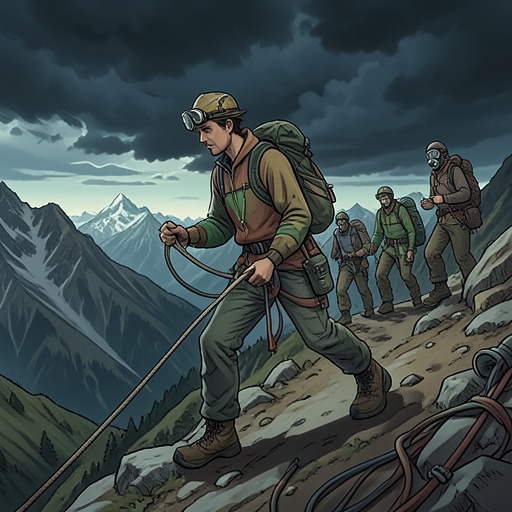
Fischer had no definite summit-day turnaround time for his clients. Although he was associated with a personal rule that climbers should turn around if they had not reached the summit by two o’clock, he did not set a precise deadline for this expedition. Instead, the plan was for Lopsang Jangbu Sherpa and the guides to take turns leading, with Fischer bringing up the rear and turning back stragglers as he caught them. If problems arose, Fischer was expected to contact Lopsang, who was assumed to be near the front. Neither Boukreev nor Beidleman had a radio. This arrangement depended on the team maintaining contact and on the leaders being able to identify trouble while spread along the route.
After helping establish the route, Boukreev waited near the summit and then began descending, intending to reach Camp IV, prepare warm drinks, and keep supplies available in case climbers needed help. He spoke with Fischer after the difficult passage of the Hillary Step. Fischer said that he was tired and that the ascent had been difficult. Boukreev explained his plan to descend quickly and prepare for the return of the climbers. Fischer agreed. At the time, Boukreev saw no immediate reason to expect the weather to worsen as rapidly as it did.
As the afternoon and evening unfolded, different parts of the party became separated, and reports from the mountain were inconsistent. Lopsang later described catching up with Fischer above the Balcony and finding him in serious trouble. Fischer told him that he was very sick and that he was dying. Meanwhile, Boukreev, who had descended to Camp IV, understood that the Mountain Madness clients had not yet arrived and might soon be out of oxygen. He began preparing to go back up as the weather deteriorated.
Lopsang tried to escort Fischer down, but Fischer was too weak to continue reliably. Lopsang said Fischer had three oxygen bottles; their later conversation also recorded uncertainty about the supply and its use. In the storm and darkness, Lopsang remained with him for about an hour, trying to persuade him to go toward Camp IV. Fischer said he could not walk and wanted a helicopter. Lopsang eventually left him in a sheltered spot, intending to send Sherpas with oxygen and tea. By morning, Fischer had died. Lopsang’s account emphasizes that he stayed with his friend and mentor, attempted to move him, and left only after concluding that he needed help and was himself becoming dangerously cold.
Boukreev went back up in worsening conditions to look for people stranded on the mountain. He later explained that he had descended to gather oxygen and warm drinks and had begun the rescue effort around six o’clock. After helping other climbers, he made a further attempt to reach Fischer. At about seven in the evening, in darkness and a serious storm, he found him. Fischer’s down suit was open, one hand was uncovered, and Boukreev saw no signs of breathing. He concluded that there was nothing more he could do and could not stay with him. His account, like Lopsang’s, places Fischer’s death within a crisis unfolding across a mountain where weather, distance, dwindling oxygen, and limited communication curtailed the available choices.
Death and legacy
Fischer died roughly five hundred vertical meters above Camp IV. Lopsang had struggled for more than five hours to get him down, but the attempt did not succeed. Boukreev later returned to the area and found Fischer’s body; he covered it as best he could, left his pack and oxygen with him, and took his ice ax and a few personal items for Fischer’s family before descending in the storm. In May, Boukreev climbed Lhotse alone, as Fischer had promised to organize before the Everest expedition. From its summit he looked toward Everest and stopped at the elevation where Fischer had last been able to reach.
The account resists reducing Fischer’s death to a single error or a supposedly decisive flaw in his character. It identifies a combination of deteriorating health, apparently compounded by lack of oxygen, the time and location at which he became incapacitated, poor communications, worsening weather, and the condition and capabilities of the people who might have helped him. Boukreev and Beidleman both said they would have tried to turn Fischer around if they had recognized how serious his condition was. The cause remains a matter of combined circumstances rather than a certainty that hindsight can cleanly resolve.
That uncertainty does not erase Fischer’s importance to those who climbed with him. Several Mountain Madness clients who had disagreements with the way the expedition was run said they would climb with him again. Martin Adams described him as a leading guide and said that he had trusted him. A year after Fischer’s death, his wife said their children called the family phone number to hear his voice on the answering machine. The detail makes the loss personal without settling the unanswered questions of the mountain: Fischer remains both the ambitious guide whose commercial hopes shaped the expedition and the absent leader remembered by the people who had chosen to go with him.